SVRA Sebring Speed Tour


Sebring, Florida, February 23 - 27, 2022   The first sportscar race at Sebring was held in 1950.  MGs were on the track competing.  MGs raced every 12-hour enduro race at Sebring for decades.  Much of the MG post-war racing history was created at the Sebring International Raceway.  Partly to experience the history, and to become part of that history, the crew chose to make the first race for the MGTF the SVRA race at Sebring.  And, in part, because the first sports car race that Glen attended was the 1959 12 Hours of Sebring.

But first, a part of the story of the race track must be shared.


Hendricks Army Airfield was built in 1941 to train pilots of heavy bombers. such as the B-17, to serve in WWII.  After the war, Alec Ulmann, a sports car racing enthusiast who was involved in rebuilding military airplanes for civilian use, saw the airport runways as a perfect place to stage a race.  The first race, in 1950, was named the Collier Memorial Race in memory of MG racer Sam Collier.  The original track layout was 5.2 miles long.  The growing needs of the current airport and industrial complex have shrunk the track to 3.75 miles long, a challenging, technical course with 17 turns.  Some of the racecourse is the original 1941 concrete and is rough, tossing the cars around.

Interested in taking a lap around the track?  Jim Pace, who was a highly regarded racer and race instructor, 
provides that opportunity through a YouTube Video.  A Lap at Sebring


SVRA is the acronym for the Sportscar Vintage Racing Association.  SVRA organized their first race in 1978 as a support race for the 12 Hours of Sebring and has been holding races every year since.  In 2022, SVRA will have 19 races, from Florida to Washington State.  https://svra.com/   The Vintage racecar that the crew has chosen to campaign this year is a 1955 MGTF.  Well over 200 cars were entered in a variety of classes and different groups.  Our MG was the oldest car and, therefore, the most vintage racecar at Sebring.  The detailed description of the car would best be accomplished in a separate post and that may be done in the future.  This image shows the car on the pit straight just past the walkover bridge.


The Sebring race schedule had competitors arriving on Wednesday to get in long lines to register, then wait for the slow process of moving the race cars and trailers into the paddock.  Thursday had practice sessions scheduled, three for each race group.  Friday had a practice session and a qualifying session to set the starting order of the first race.  Two races were run for each race group, one on Saturday and one on Sunday.  A long weekend and a lot of track time.  This image is of the TF in race #1 on Saturday.  Fellow MG owner, George Butz, captured this shot.


All of the action at the races doesn't happen on the race track.  The paddock, where the cars, trailers, and crews are located, is always active with work on the cars.  Changing race setup to reduce lap times and effecting repairs keeps all the crew busy.  In this image, the crew looks contemplative, considering the next step.  Geoff Ashcroft, the driver, Tony Cassata, and Dave Burrows are pictured here.  Geoff, Tony, and Dave, all good friends, came to Sebring to aid in the maintenance of the race car.  This image could be one used in a caption contest.


Another photo of the crew appropriate for a caption contest.  Three heads are better than one?  Brain Trust?  Tony Cassata, Dave Burrows, and the driver study a broken throttle linkage shaft and consider repair possibilities knowing that a new part is not available.  A fix was determined, changes made, working correctly for the rest of the weekend.  A true repair will be made after the car returns home.


Sebring proved to be an enjoyable race and a true shake-down for the car before a journey north to experience some favorite race tracks with long histories of MGs racing.  Many thanks to all who helped with the car during the weekend.  A true adventure among classic and fast cars.  Now, the Moore MG is a part of MG Sebring history.


HSR Classic 24 Hours


Daytona, October 30, 2021   This blog has focused on classic cars and on fast cars.  This blog post will be the first of a series focusing on classic cars that are fast and continue to prove that by racing in competition.  The above photo has a Corvette C7.R leading a group of cars out of the International Horseshoe corner at Daytona International Speedway.

HSR is a sanctioning body for vintage racing, although the cars that race in their series are not very vintage.  They avoid the vintage name in their title - Historic Sportscar Racing - with historic having a broad definition when it comes to the age of the cars racing.

However, as with all vintage racing, the atmosphere is relaxed with the spectators having access to all areas of the racetrack and the pits.  In the pits, the drivers and mechanics take time to share information and stories.


The pits are like a museum of historic race cars.  This car is a Porsche 935, one of the most successful race cars of all time.  The 935 won races all around the world and dominated the GT classes for years.  A 935 even earned and overall win at the Rolex 24 Hours of Daytona beating the prototypes one year.


In the prototype class, the Porsche 962 was dominant from the 24 Hours at Daytona to the 24 Hours de LeMans.  There were multiple 962 at the Classic 24 Hours.  They are beautiful cars that are fast and reliable.  They are also rare and desirable, which has moved their sales prices above $1 million.  Million dollar cars out on the race track.


And, those in attendance not only get to see the cars up close and personal, they also get to examine all the engineering and technology as the crews work on the cars.  This is another of the 962s at the Classic 24 Hours. 


Another piece of racing history, a 1982 Jaguar XJR,  This car one many sportscar races and was the leading technology of its time.  Again, successful from the Daytona 24 Hours to LeMans.  This example is one prepared and raced by the Bob Tulius organization, Group 44, thus the chosen race number on this car.  Another car in the race must have registered earlier wit the 44 number, so the Jaguar team added a 1 before the number.


It takes a lot of tubing to make exhaust headers for a V-12 engine.  Today's sportscar prototypes are very similar in design due to restrictive rules designed to keep competition close.  Racing began, and continued for decades to be an experiment in how to make cars better - more powerful, better handling, more reliable - with many variations in design.  Jaguar chose to compete with a naturally-aspirated V-12.  Porsche chose a twin-turbocharged flat-six engine.  Again, vintage racing allows one to closely examine the engineering, design, and construction of race cars.


A much newer version of the prototype race car, a Cadillac built to the newer Daytona Prototype standards.  It was originally built and raced by the Wayne Taylor race team located in Orlando, Florida.  This Cadillac enjoyed much success with numerous race wins and a couple of season championships.  Historic, yes.  Vintage, no.


Another car with a very recent racing history, the Corvette C7.R, which raced with much success in the GT class though the 2020 season.  This is one of the first C7.Rs, a 2014 model.  There were two of the C7.Rs entered.  On the track, at this race, they were faster than many of the prototypes.  The machine hooked up to the engine was an engine warmer, running hot water through the engine so that it was warm on start-up.


This 2012 Cayotte Corvette represents an earlier Daytona Prototype formula.  This car design, which had support from General Motors in development, was succeeded by the Cadillac.  It was difficult to get a clear photo of the car because of the girls in outfits matching the car always standing in the way.


A 1969 Lola leads a couple of older Corvettes and a gaggle of Porsches.  Finally, a car that meets many racing organizations definition of a vintage race car - 1972 or before.  These cars all look at home at Daytona because they all raced there in their period.


A Lamborghini leads another gaggle of Porches with a yellow Ferrari thrown in the mix.  There are many vintage racing sanctioning bodies organizing races across the county - HSR, SVRA, VSCCA, VDCA, VRG, VSCDA, and more.  Vintage Racing has become more popular, giving amateur racers a chance to experience racing on some of the greatest race tracks in the world.


A shot of only Porsches, the ever-popular race car of the 911 chassis.  The design of the car evolved over decades, although the  basic body design was always similar and recognizable.  There were many race cars built, and they were reliable, a formula for having many still racing today.

Vintage Racing - a new and popular segment of the motorsports and classic car hobbies.
Find a race near you to experience yourself.


Amelia Island Concours - Historic Fashion


The Amelia Island Concours celebrates many aspects of the car culture, including period dress and fashion matching the vintage of the cars displayed.  This family dressed in appropriate golf attire along with their 4.0 Liter, DOHC, overdrive, 1939 Bentley.


An earlier car and an earlier fashion period - 1914 Rolls Royce Silver Ghost.  This car had been converted into a farm truck in the 1940's.  It was found by a collector in 1999 and restored to its original 1914 configuration.


1919 Pierce Arrow 66-A-4.  This flashy car has a custom body designed by Harley Earl and was originally owned by silent-movie star Fatty Arbuckle.  It has an 825 cubic inch overhead cam engine.


1925 Kissel 6-55 Goldbug Speedster.  This car was designed to be a sporting runabout, with rear fender mounts for your golf clubs on both sides.


1951 General Motors LeSerbe prototype, a type of car that General Motors often billed as Dream Cars.


1952 Muntz Jet - A car built by "Mad Man" Muntz as a promotion of his car business rather than a business enterprise as he lost money on every car built.  The car was designed by the Indy racecar builder Kurtis.


There are not any descriptions of the fashions, only images for your own analysis.  This is a car blog, so the focus, appropriately, is on the cars.  But, the fashion aspect is an interesting part of the Amelia Island Concours.

GOF South LIV


The 54th annual Gathering of the Faithful was scheduled to be held April 17 - 19, 2020, at the Mission Inn, Howey-in-the-Hills, Florida.  This, sadly, is not a report of an enjoyable car event, as so many of the posts in this blog document.  It is a report of what should have been a great event that was forced to cancel due to the Corona Virus Pandemic.  There is no way of predicting, but car event cancellations may become the norm for 2020.

The Classic MG Club of Orlando, the founder of this event in 1967, was the hosting organization.  Members had been working for over a year to plan the details of this event.  A wide variety of ativities had been planned for the weekend event, more than could fit in anyone's calendar. There were workshops, dinners, raffles, silent auction, and a car show.  A big car show.  Over 100 MGs were registered 6 weeks before the event - the time that the decision had to be made for canceling the event.


The most anticipated activities at the GOF South were the rallyes and drives.  Multiple drives.  One of which was a drive to a mountain top.  Yes, a mountain top . . . in Florida.  Sugar Loaf Mountain to be specific.  Well, in fact, two rallyes to the mountain top.  So many had signed up for the rallye that two different routes had to be planned to reduce the size of the group on the road and to lower head count at the possible restaurants scheduled for lunch.  The Rallye de Montagne, with a logo appropriated from the famous French Monte Carlo Rallye, was to be a highlight of the weekend.

.


Not far from Howey-in-the-Hills is the quaint town of Mt. Dora.  It has become a town of many, quality restaurants and interesting shops.  A drive, the Mt. Dora Meander, was mapped out with appropriate rallye-type instructions to take the MGs and their owners from the Mission Inn to enjoy a lunch at the restaurant of their choice.  The route home passed through the neighboring city of Tavares, also known as the seaplane city, since they have a seaplane port on the lake right downtown.  A full afternoon of driving your MG on back roads, enjoying a meal with your friends, and seeing new sights was on tap.


Many rallyes and drives were planned, more than could fit into the weekend.  There was a suggestion offered that participants arrive on Thursday, a day before the official opening of the GOF South, to make one of the rallyes during the extended stay.  A new event, the Tweed Drive, a drive to a British restaurant with participants all dressed in tweed or in their British Finest.  This event was patterned after bicycling events that have been held across the globe.  The links below are to videos of Tweed Runs.

https://www.youtube.com/watch?v=7qlU7y-LHqc

https://vimeo.com/252362547


There was a drive to the Yalaha Bakery, a popular German bakery and beer garden.  Who wouldn't enjoy that?  As participants left the GOF South to return home, multiple blueberry farms were mapped out to brake up the drive, enjoy picking blueberries with MG friends, and have some delicious, healthy treats.

Disappointed.   As are many who have faced canceled events.  There is some hope as we look to the future.  GOF South Mk 55, presented by the MG Classics of Jacksonville, is scheduled for April 2021, to be held in Gainesville, Florida.  And, the Classic MG Club of Orlando plans to return to Howey-in-the-Hills in 2022.  Seems so far into the future.

MGs at Amelia Island Concours d'Elegance


The 25th Annual Amelia Concours did not have an MG class this year, however, two cars were selected to be displayed on the main show field, chosen to represent sports racers of their period.  The pre-war race class included a 1932 MG J2.


The J2 had recently finished a full restoration by Safety Fast Restorations, a company that specializes in pre-war MGs.   The car gleamed in the sun with its original duo green colors.  It is powered by the factory 847cc single overhead camshaft engine with a cross-flow 8 port design.  Quite advanced for the day.  J2s were successful on the race tracks in England, just as they came off the assembly line.


The J2 is the first MG with the long hood and cut-down doors that came to be synonymous with MG sports car design through the 1955 MGTF.  In 1933, they were also offered with swept wings (fenders) that became another standard of MG design. The J2 was produced for only two years: 1932 and 1933.


It is interesting to see MGs represented at the Amelia Concours, particularly in the racing category.  MG achieved many race and rally wins and set many land speed records during the 1930s.


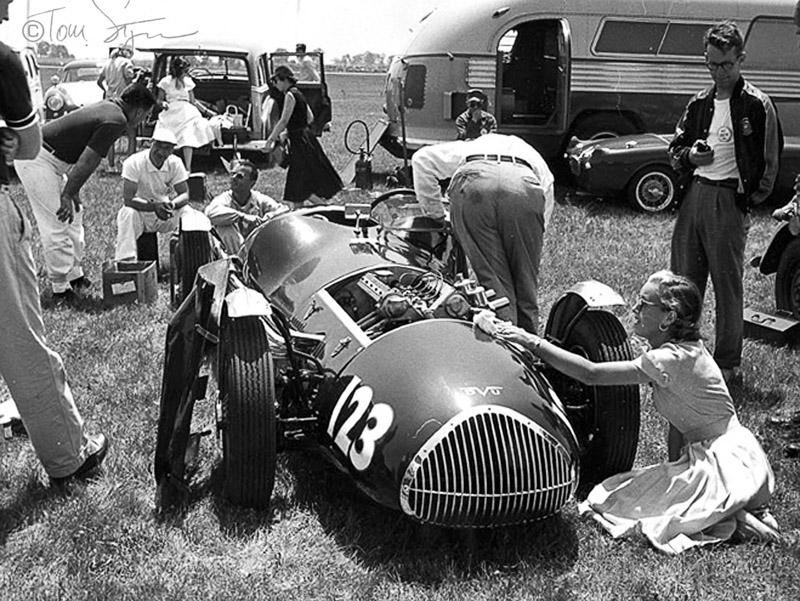
The blue car is a 1953 MGTD, not that you would recognize it as such.  In the 1950’s it was popular to build sports racers based on MGs that were called MG Specials.  Ken Miles, of the Ford GT LeMans fame, built four MG Specials, all successful on the race track.


This MG Special was built by David V. Uihlein with the intent to build parts to sell to would-be racers so they could transform their MGTDs into race cars.  It looks a bit like a 1950's Indianapolis roadster because Uihlein had an Indy Car builder craft the body out of aluminum.  The car weighs 600 pounds less than an MGTD.  For power, Uihlein designed a double overhead camshaft head with double hemispherical combustion chambers, cast from nickel-alloy steel, fitted to an 1250 cc XPAG engine.  With twin SU carburetors, it produced 90 horsepower.  Unfortunately, it did not produce wins on the race track and only one was built.  The 4 separate exhaust pipes running down the side of the car give it quite a distinctive look. 


The Amelia program described the car as “an example of an elegant and efficient design with a rather impressive mechanical setup.”


At the racetrack in 1953.


MGs at Amelia Island Concours - Cars and Coffee


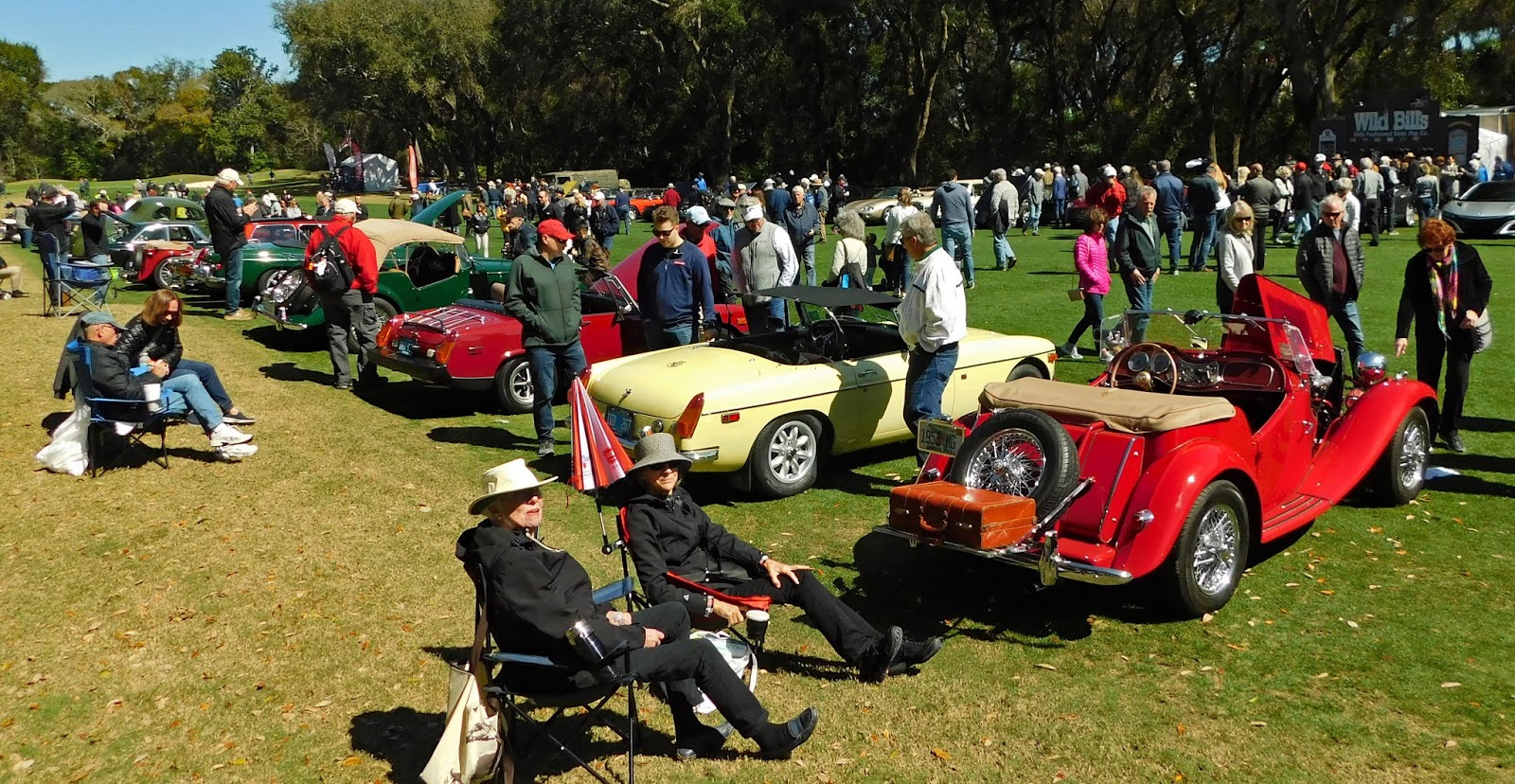
The big show at the Amelia Island Concours d'Elegance is on Sunday.  On Saturday, they host a Cars and Coffee, filling two show fields.  A wide variety of cars are selected for this show, including a number of MGs in the British category.  A great benefit of this show is that it is free admission for spectators.  This allows families with children a chance to attend a large car show and provides an opportunity for car hobbyists to share their cars with many people.


Many of the MGs were brought by members of the MG Classics of Jacksonville Club as a club activity to promote the classic MG hobby.  The numbers on these two MGBs were from a recent TSD rallye - The Dixie Brit Rallye.  Each car in the rallye was provided with the traditional racing numbers place on a white ball.


Amelia Island Concours was blessed with beautiful weather for the 25th-anniversary edition, March 5 -8, 2020.  They were also fortunate to have moved the event forward one week to allow the nearby PGA tournament to occur the second weekend in Ponte Vedra without two major events conflicting.  Travel and group gathering restrictions began a few days after the Concours, making it one of the last international events in the world, spring 2020.

Here, a beautiful MGTD is properly displayed with additional items enhancing the presentation.


This TF is in original condition, sometimes referred to as preserved.  It has never been restored.  The paint, in almost immaculate condition, is the original, factory-applied paint.


This red MGTC was a favorite among the kids in attendance.  The owner generously allowed all the kids an opportunity to sit in the car.

Displaying MGs in events that draw large crowds of the general public and large number of car enthusiasts from a wide variety of marques, may be the best promotional activity for the classic MG hobby.