GT-43


A grand tourer (Italian: gran turismo) (GT) is a performance and luxury automobile capable of high speed and long-distance driving.  The most common format is a front-engine, rear-wheel-drive two-door coupe' with either a two-seat or a 2+2 arrangement.  Wikipedia

GT is a European classification of cars often used to tour, rally, or race on the public roads.  The MGA coupes displayed above certainly meet the definition of a GT.  Although here, GT is used as a much simpler term, just an abbreviation for "get together."  It was the 43rd year the NAMGAR (North American MGA Register) has gathered to show and appreciate the MGA and other MG's built during that time period.


The featured car at the GT-43 was the MGA Coupe.  Since Jill's Little Blue Coupe is one of the few coupes made, and the fact that GT-43 was held in the historic and beautiful town of Richmond, Virginia, the decision was made to head north and join the other MG enthusiasts.


The Virginia Crossings Hotel, a beautiful facility built in the Jeffersonian style, was chosen as the site for GT-43.  With little time to make the event and then drive to Michigan to launch Last Dance, the coupe was trailered to Virginia.  The little Escape performed well with the MGA in tow.


Since the coupe was the featured car, a display of the coupes was organized on the front lawn of the Crossings.  The image at left is the cars on the left of the cannon, with the owners standing next to their cars.  The first car is Jim Cheatum's recently restored Mineral Blue Coupe.


And to the right of the cannon, four more coupes with Jill standing by her Mineral Blue Coupe.  This paint color was original to the coupes and was not used on the roadster.


To welcome participants who have not attended a GT before, or those who have but have a new car, a show of First Timers is held.  This British Racing Green roadster set up as a cafe racer was one of our favorites.  It had just undergone a total restoration.


This car sported an original Judson supercharger with an external oiler.


Another favorite was this red 1500 roadster which was flawless.  It won its class in the big show.


There were over 160 cars displayed for the show judging, divided into multiple classes.  Right is a small class of two - two Twin Cams, an engine developed for racing.  One of these cars has a racing history.


One class is known as Premier.  It is comprised of cars that won their class in the previous couple of years.  The best of best competing with each other.


There is much more to the GT than a car show.  There were workshops, drives, visits to historic sites in Richmond and history lessons on MGAs.  The car in the image at right is famous for being one of the three-car MG factory team at Sebring in 1959.  It has a twin cam engine and a coupe body.


The car was prepared with a hood scoop, seemingly normal for a race car but a much different function on this car.  Hood scoops traditionally bring large amounts of cool air to the engine intake system.  This hood scoop is ducted to the driver's compartment, bringing cool fresh air to the drivers.  The MGA Coupe is known to be a hot car.


Workshops were held inside the hotel conference rooms on a wide range of topics from fuel and oil for classic cars to a full rebuild of an MGA.  The most famous of MG mechanics, John Twist, ran a workshop on tuning MGs while actually tuning participant's MGAs.  Many left the GT with better running cars.  Here John syncronizes carburetors using a hose and an ear.


A number of drives were held, mostly on back roads, with destinations of interest.  One was to a museum which wasn't a museum, but it was most interesting.


Richmond Auto Museum is in an older industrial area where a building that once housed a small manufacturing plant now home to classic cars.  The coupes were the first to arrive.


The main function of this museum is not to display cars, it is to store cars.  When you get into the classic car hobby, it is easy to purchase more cars than will fit into your garage.


Individuals can rent a space to store their car(s) freeing up space at home, maybe allowing them sufficient room in the garage so that it functions as a workshop rather than just storage.  There is a high-tech computer system for security and to keep track of comings and goings.


There is also a workshop in the museum, complete with a lift.  This Alvis was in the shop area during our visit.  When was the last time you saw an Alvis?  Was the rabbit hood ornament on all Alvises or just special models?


There is a formal meeting room at the front of the building.  As you enter the doors you are greeted by an MGTC.  Most appropriate, in our opinion.


The group from the GT enjoyed a box lunch after the tour of the "museum".  A Jaguar XKE was part of the room decoration.

Oh, to have such a facility close to home allowing the collection to grow!


A gathering of people needs something for fun and games.  At GT-43, one evening had valve cover races.  A valve cover, preferably off an MG engine, is modified into a race car powered by gravity.  There is a set of rules, but creativity is prized.  This racer was even prepared with a driver.

NAMGAR members and, in particular, those from the Central Virginia Chapter organized a great and enjoyable event.  Thanks!


Private Collection in Florida


Somewhere in Florida, March 2018

The classic car hobby preserves automotive history.  It could be argued that many classic cars are true art expressed in a form that also has function.  Cars have been the subject of displays in many an art museum, including the Metropolitan Museum of Modern Art in New York.  This private collection is an art museum, one we were fortunate to experience.

The collection consists of over 20 cars and over 1000 Automotive signs.  Signs are quite collectible and are included in many of the high-end classic auto auctions.  This may be the largest and most diverse collection of automotive signs in the world.

The car above is a special that Edsel Ford had constructed out of the sight of his father.  Henry Ford believed that engineering was the most important aspect of the car industry and focusing on styling was a pursuit for those whose manhood might be called into question.


While a focus of the collection is on Ford and Mercury products, some Chevy's made it into the collection.


This collection is fluid, with new cars added and other cars sold.  The framed display commemorates the first-place award at the Pebble Beach Concours d'Elegance, the most prestigious classic car event in the world.  This winning Dusenburg was once part of the collection.


Charles Knight developed a sliding valve engine which has two cast iron sleeves between the piston and the block.  These sleeves move so they uncover intake and exhaust ports in the side of the block.  Confusing?  After years of reading references to sliding valve engines, this cut-away working display engine finally demonstrated how that system works.


Thirty automotive manufacturers, in eight countries, built these engines for their cars under Knight's patent, which was awarded in 1905.  Cars with the Knight engine were allowed to use the Knight hood ornament on their cars and were referred to as "Silent Knights" as the engine was almost noiseless in operation.  By 1932, poppet-valve engines, which were less expensive to build, became the norm for 4-cycle engines and the Knight engine production ended.


A Knight engine in a Willys-Knight, built during the WWI era.

There are many stories of automotive history on display in this private collection.  This post just scratches the surface of one story.


SCCA May Showcase


Daytona International Speedway, May 6, 2018

Fast Automobiles is part of the title of this blog.  Recent posts have focused on classic cars sitting still on the fine grass of the golf course at Amelia Island or inside a building serving as a museum.  So, it is time to take a look at fast cars, and back to Daytona International Speedway again.  But, this time a different experience with different forms of racing (going fast in cars), forms open to everyone - SCCA amateur racing.

The image above is of the pace lap for one of the road races, utilizing the full 3.56 mile long road course.  The race cars are Spec Ford Racers, a car built just for SCCA racing.  All cars are identical with engines sealed so that all cars have the same horsepower, leading to close racing based more on driver skill than mechanical modification.  More on road racing later.

The event this weekend is billed as the Central Florida Region SCCA May Racing Showcase, with all forms of amateur auto sports featured at one site at one time.  A bit like a three-ring circus, but with 5 rings of activities happening.


Rallycross


The newest form of racing under the SCCA umbrella of sanctioning is Rallycross, raced on a small, tight course over a dirt field.  This one began as grass-covered, but was quickly being changed into a large dirt grove that driver negotiated.  The course is defined by traffic cones and drivers negotiate the course one at a time.  Placement in the competition is based on fastest time, with time penalties accessed for knocking over any cones.  It is basically autocross racing on dirt.


Some of the cars are prepared for this type racing with suspension modifications and changing tires to ones with a more aggressive tread pattern.  Others are just peoples' daily drivers - drive them to the track, drive them home, drive them to work on Monday.


Autocross 


Racing sports cars on tight circuits laid out in parking lots or on unused airport runways have been occurring since WWII left unused runways and suburbia spawned shopping malls, which in the 1960s were all closed on Sunday, leaving huge expanses of asphalt empty and inviting.  Daytona International Speedway offers a different racing surface for the autocross racers, a sprint kart track.

Karts invade Daytona for a week of racing between Christmas and New Year's, and have been for many decades.  One form of kart racing, road racing, uses the large banked track, another, Sprint Racing, uses a smaller, shorter, tight track.  Daytona constructed a sprint kart race track in the infield inside NASCAR turns 3 and 4, that proved to be perfect for the tight circuit required for autocrosses.  Of note in this image are the people standing out on the course.  It takes a lot of personnel to operate an event and, in amateur racing, it is all volunteer workers.  So, all of the participants racing in an autocross event are expected to spend a period as a course worker.  On the parking lot tracks, where the entire course is defined by traffic cones, they get a lot of exercise replacing cones that have been knocked over.


This is one area where a classic car or two will appear.  Here an early Camaro is making a quick lap.


The class structure is large and broad, having a place for any car that might show up to be included in a group of like performance cars - even karts.  A tight autocross course rewards handling more than horsepower.  The fastest Ford was a Ford Focus (44 seconds), quicker than the fastest Mustang (45 sec), however, the fastest vehicle on the track was a kart (37 sec).  This old kart racer enjoys that fact.


Many stories are in this image.  A Honda S2000 is at the start line to begin one of his laps on the course.  The electronic timing eye is in the green milk box next to the track.  In the background, the silver car heading to the right is approaching a pair of orange milk boxes, which contain the electronic eyes at the finish of the lap on the course.  That car is interesting in that it is a Kia Rio, an economy car not known for handling, speed, performance in any way, other than gas mileage.  Autocrossers are non-judgemental in the type of car one chooses to enter.  Their motto is to race whatever car you have - there is a place for everyone.  Farther in the background, a group of road racing cars on a pace lap before the start of the race.  This event's structure allows a lot of racing to be experienced.


Road Racing

Sportscars have been racing on road courses for over a century.  At first, the road courses were actual roads that were closed for use as a race track.  The Watkins Glen races began that way in the late 1940's.  Crowd control and safety moved road racing to purpose-built courses almost entirely by the mid 1950's.  Movable concrete barriers and larger budgets have returned a few races to city streets, in Long Beach, California, and St. Petersburg, Florida, for example, but those race tracks are much shorter and in a more confined space than the road race tracks that once were comprised of city streets.


The Daytona track was built in the late 1950's to showcase stock car racing on a banked track which provided higher speeds and better viewing by the fans.  A road course was added by placing a circuitous paved path through the infield.  Here the Sports Racing Fords lead a group out of the corner known as the International Horseshoe.


Most sportscar road racing events have multiple classes on the track at the same time - SCCA even more so with eight or more classes running together.  So, the Mustang on the inside is not racing the #48 Miata for class win.  Of course, on the track every driver's ego has him/her trying to outperform everyone else.  The Mustang is in a Grand Touring class and the Miata is in F Production.  A Sports Racing Ford and a couple Spec Miatas can also be seen in this photo.  SCCA's road racing class structure is much too large to be considered here.


Most of these cars are all in the Spec Miata class.  The cars are basically stock Mazda Miatas with a few, specific modifications allowed.  This class has a low cost to enter and provides very close racing.  This multiple class race had over 60 cars on the track at the same time with close racing throughout the field.  There is a saying among amateur racers that no matter the question - Miata is the answer.  As can be seen here, Miatas are racing in all types of racing at this SCCA race.


PDX, Track Days, Ride-a-Longs, and Road Rally

In addition to the three largest, most visible racing events at the track, there were numerous other autosport happenings.  Performance Driving Experience (now moving to be titled Track Days) gives people a chance to take their cars out on the race track to run high speed, but closely supervised laps.  On Friday, people who had never been on a race track could, for an entry fee, run laps around the 3.56 mile Daytona road race circuit, which includes the high banks and the infield corners.

On Saturday, Ride-a-Longs were offered to allow people to ride with a racer.  In all race venues - road racing, rallycross, autocross - rides with a driver were made available.  Since road race cars typically only have one seat, rides on the big track were made in the street cars entered in the PDX event.  Helmets were loaned and people got to feel what it is like to be on a race course first hand.

RoadRally

Road rallies are held on public roads with local laws being observed.  Outright speed is not the objective, precision driving and navigating are rewarded.  These events were once called TSD Rallies, for time/speed/distance.  A route, usually on back roads, is laid out and accurately measured.  A list of instructions is prepared to direct each driver/navigator along the route which is unknown to the competitors prior to starting.  Sections of the route have a prescribed average speed to be maintained.  Each car is required to follow the course, based on the instructions, maintaining the speed.  The rally is divided into segments, called stages, with surprise checkpoints timing the cars arrival time.  Penalty points are given for each second early or late that the car arrives at the checkpoint.  The winner is the car with the fewest points.

The May Showcase has many fast car events all rolled into one weekend.  There are numerous ways that those who have an interest in fast cars can actually experience traveling fast.  More details are available in the program prepared by the organizers of this event, the Central Florida Region of the Sports Car Club of America.

Showcase Program - Central Florida Region SCCA


Majors Motors - Private, Now Public Collection


Winter Park/Orlando, Florida, March 22, 2018

Majors Motors, MLounge, and MBar.  It can get confusing.  A car collector purchased a building in a commercial/retail area between Winter Park and Orlando.  He opened a roof-top bar, called the MLounge.  On the first floor of the building, he housed his car collection of over 60 cars. The collection is known as Majors Motors.  MLounge proved popular.  However, the patrons would peer in the windows on the first floor and see all the cars, asking how they could get inside to see them up close.

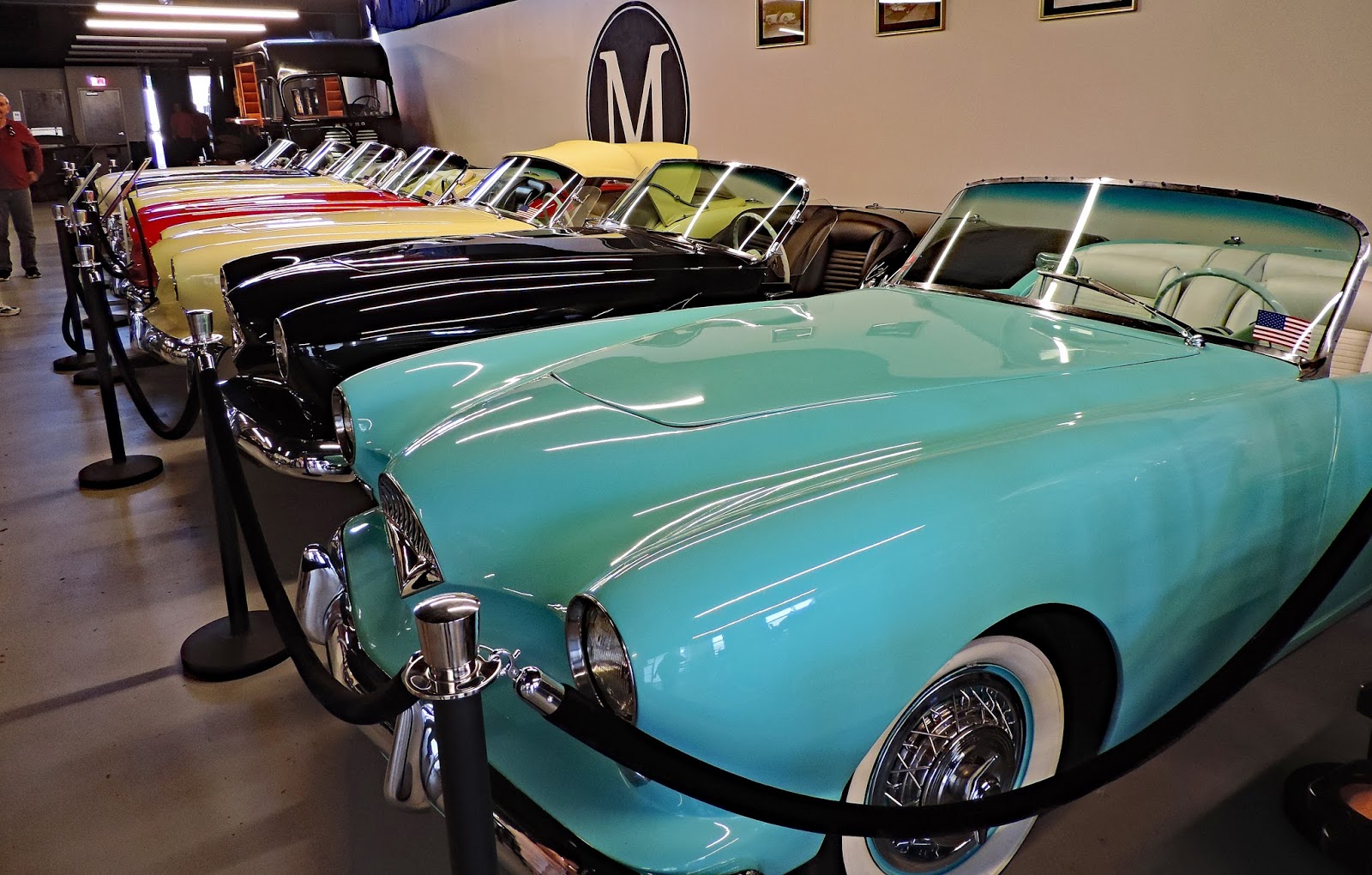
With the demand to see the cars getting always higher, he decided to make his private collection public.  When the first floor was a private museum, the cars were spaced throughout the area for perfect viewing.  Turning it into a public space, now called the MBar, required the cars to be moved close together next to walls - not nearly as good for viewing, but more people get to view . . .  including the participants at the Gathering of the Faithful who rallied in their MGs to a private showing of the collection.

Above is an MG bar, constructed from a late MG Midget, located just outside the entrance door to the MBar.  Always good to tie MGs into a post on the blog.  It is sad, in a way, that the passenger door has been removed and the floor cut out so the server can stand near the middle of the car to interact with customers.  A sheet of Lexan has been attached to the car to provide a smooth, level surface to function as a bar.  It is positive that the bar will allow people to interact with an MG who would otherwise not do so, even if it is in a way far from its intended purpose.


Entering the MBar one is met by a collection of microcars.  There are thousands of possible categories of cars that could be collected.  One that this collector chose is the microcar, tiny cars designed to transport people economically, both in gas mileage and use of materials.  First in the display are a Morgan 3 wheeler and a Fiat Multipla, possibly the first minivan, or maybe a mini-minivan.


Then, the Messerschmitt KR 200 was opposite.  So, a British, Italian, and German microcars right off the bat.  The Messerschmitt demonstrates why these cars were known as "Bubble Cars" in their heyday of the late 1950s.  It was the dislike of the bubble car style that motivated Alec Issigonis to design the more traditional appearing Mini, which became a hit and was produced through the 2000 model year.


From the small (appropriately) foyer containing the microcar display, one enters a large room ringed with cars shoulder to shoulder.  The cars have been moved to the sides to provide room for events in the MBar.  The day the GOF visited, the staff were setting up for a private event, a fundraiser they were hosting that evening.


Many cars from many manufacturers are part of this collector's interest.  Here a red Ferrari sits next to an Austin Healy 3000 and a Nash Healey.  Yes, the same Donald Healey was the major force behind both of the Healeys, very different cars.


Donald Healey was so impressed with Briggs Cunningham's success at the LeMans 24 Hour race with the modern Cadillac overhead-valve V-8 engines (see post 1950 Cadillac LeMans) that he made a trip to the United States to meet with General Motors in an effort to acquire Cadillac engines for a car he was designing.  GM turned him down.  On his trip back to England on the Queen Mary, he met George W. Mason, CEO of the Nash-Kelvinator Corporation, a manufacturer of cars and refrigerators.  A partnership was developed and a 6 cylinder Nash engine was mated to Healey's car.  The engine was given a few more horsepower by replacing the cast-iron head with a high-compression aluminum one and feeding the engine through two SU carburetors, popular on British sports cars.  The Nash Healey arrived in the U.S. in early 1951, two years before the Corvette.  It did have some racing success as a Nash Healey finished 1st in class and 3rd overall at the 1952 24 Hours of LeMans, behind two Mercedes Benz 300 SLs.  The Nash Healy led a short life with production from 1951 until 1954, as high production costs of the Italian made, Pininfarina-designed aluminum body and Healey's interest in his new Austin Healy 100M doomed the Nash engined car.  One can learn a great amount of history at an auto museum.


A couple Allards, another British car, are in the collection.  The Allard was another British chassis/body powered by an American power plant.  (And, most think that marrying a light-weight British car with a powerful American engine was an original idea of Carrol Shelby with the 1960s Cobra.)  Shipping engines to England was problematic, so in the early 50's Allard shipped cars to the U.S. without engines, installing Cadillac, Chrysler, Buick, or Oldsmobile V-8 engines when they arrived in the states.  Carrol Shelby raced Allards and Zora Duntov (designer of the Chevy Corvette) worked for Allard from 1950 to 1952 and raced for Allard at the 1952 and 1953 24 hours of LeMans.


The passion of this collector may be Kaiser Darrins.  The industrialist Henry J. Kaiser began building cars after WWII.  In 1951 they introduced a car considered advanced in design, the Henry J.  A designer working for Kaiser, Howard "Dutch" Darrin secretly designed and built a fiberglass body to fit the Henry J. chassis.  When shown to Mr. Kaiser, he railed that they were not in the business of building sports cars, but his wife said as soon as others see this car they will be.


The Kaiser Darrin is the first fiberglass sports car, being introduced to the public in 1952, two months before the Corvette.  Chevrolet and Ford (Thunderbird) also thought a two-seat sports car was a good idea.  Many problems plagued Kaiser Motors, including 50 of the Kaiser Darrins being destroyed in a storm, resulting in Kaiser Motors merging with Willis (Jeep) and the Kaiser cars being discontinued.  Only 435 Kaiser Darrins were produced, all as 1954 models.  Nine Darrins are displayed in this collection.


One innovative design feature Dutch Darrin built into his car was doors that slid into the front fenders rather than hinging outward.


Well, if you are going to turn a car museum into a bar, how do you construct the bar?  Out of a car, of course.  A Cadillac in this case.


And, you need shelves behind the bar, so why not make use of a British Singer arranged vertically?


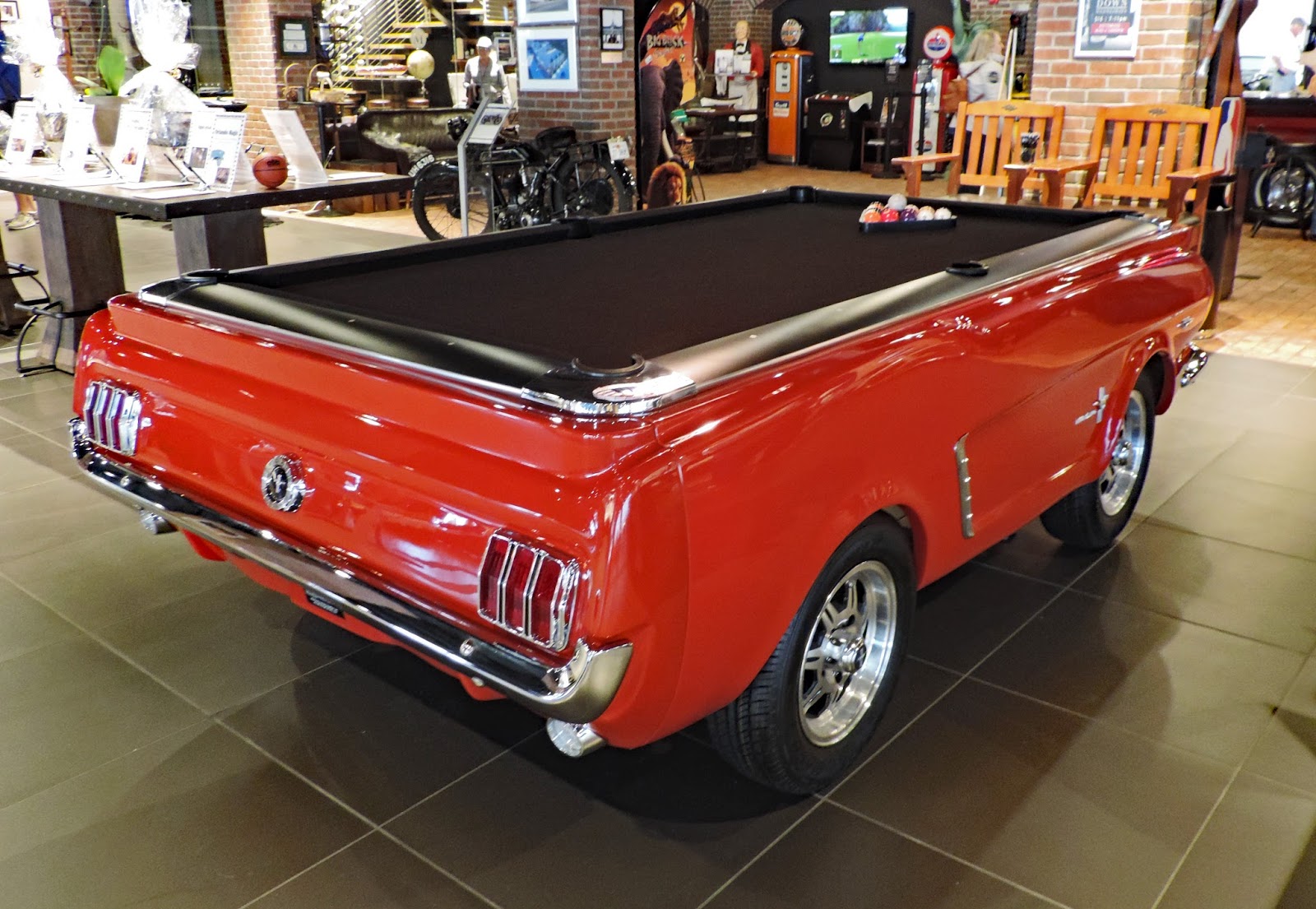
The car theme carries on throughout the MBar,  The pool table is built on a shortened 1965 Mustang.


The seating in this area is inspired by 1959 Cadillacs with a Cadillac V-8 engine as the coffee table base.  The automotive theme is carried out everywhere.

Part of collecting rare and antique cars is the joy of sharing them with others.  This collector has been able to share by expanding his business model.


If you find yourself in the Orlando area, consider working a visit to the MBar into your schedule.  The MBar has limited hours, different from the roof-top MLounge, and is often used for private events, so check before planning a visit.  For more details and to find hours, check their websites - Link to MLounge   Link to MBar  Link to Majors Motors